Saturday, 16 April 2016

Art and Kites in the Chilterns

Not much of a slope but with special, super-lube mud
it was too much of a challenge for our 4x4 Kuga.
Each year we help with the set-up for Sarah's SBA Botanical Art exhibition, and we’re always on the hunt for a new base away from the noise and rush of London, somewhere to relax and wind-down after all the noise and rush of the capital. This time we stayed in the Chilterns, at the lovely Cholsey Grange CL site.

The drive down was easy. Glorious sunshine all the way. As we neared the Chilterns the clouds began to gather.

We arrived in the rain.

Ted, the site owner, warned us the field might be muddy, and he was waiting to help us onto the pitch. A good thing, too. My attempts at using the motor mover for the last bit of fine tuning to our position, failed when all it achieved was to drive the jockey wheel deep into the mud and to scoop out two neat holes for the ‘van's wheels, all ready for more fun when the time came to pack away a few days later.
Red Kite. Small image to conceal
fuzzy focussing
An exciting start to our visit.

The views from the site are lovely. There are Red Kites flying overhead. The only time they disappeared was when I took my camera out. I’ve included one fuzzy picture just to prove that I at least tried. The site offers free WiFi, which was much appreciated and something I've never come across on a CL before.

Lovely sunrise on Monday

There were plenty of walks around the site, and we did have some time to explore on the first day, but not enough, because we were here on a mission. Our trips into London involved early starts on both days, but at least we were able to enjoy some impressive dawn colours while munching our breakfasts.
A misty start to Tuesday morning


We’re still trying to figure out a way of getting into London itself without having to sell the house and indenture the children into the chimney sweep profession to afford it. (The kids are in their thirties, now, so they'd probably put up an argument, anyway.) This year we elected to drive to Amersham, park at the station then use the Oysters to travel in. Here’s what I learned: Peak hour ends at 9.30 am, and then runs 4.30 until 7.00 pm. Outside these times the costs are manageable. Travel during these hours, as we did in error, and yes, you do need to sell the house and if you have young children they need to adopt a fake, Dick van Dyke cockney accent and learn the words to a few songs, like Chim-chiminee, chim-chiminee, Chim-chim-cheree.


Another thing I learned this week: I found out how much work is involved behind the scenes of a big art exhibition. I always thought it was just hanging pictures on a wall, but no, they have to be numbered to match the catalogue. They have to be arranged so they look good on a wall. They have to be carried.
This is how the exhibition room looked before we started.
By the time we left the walls were full of exquisite
paintings and soon the room will be packed with visitors.
There are stickers with bits of information, and these have to be stuck on the wall next to the correct painting, and they have to be straight. The glass on the paintings has to be polished to get rid of all our finger prints. Polishing 600 plus paintings is no picnic, believe me.  There’s also a shop to be created from nothing, and the extra heap of work involved in doing that job is another thing I'd never appreciated before. I’m only mentioning the things I know about. While we were working a whole army of helpers were doing other things to make it all come together. Next time you visit an art exhibition take a look at the number stickers and ask yourself who stuck them all on, and don’t be too harsh if some of them are a bit wonky.
Even better, visit this one. The SBA exhibition,  Shape Pattern, Structure.  It's on now until 23rd April at Central Hall, Westminster. If you spot any misaligned info stickers next to any of the paintings they're not mine.

As hinted. The pack away was not good. It has been a long wet winter. Lots of rain equals lots of mud. Our trusty 4x4 Kuga didn't have the grip to reverse up to the towing hitch. It is hard to line up the approach when you're car is skating around like Torvill and Dean having an off day. We did Ted a favour, though. We took some of his mud home with us - on my jeans, on my wellies, in my wellies, all over the car, all over the front of the caravan...  that we'd polished and cleaned just five days earlier!


A good few days away but right now I need another caravan holiday for some rest and recovery. But I have to get the hose pipe out first.


Travelling in a Box, the book, available on Kindle and paperback.


Sunday, 20 March 2016

Caravan in Chirk

At last our caravan season has begun, and we’re in Lady Margaret’s Park in Chirk, near Wrexham.

We didn’t get off to a smooth start. We had the caravan serviced last month, and if I’d troubled to look inside, after the service, I’d have noticed how the radio and other electrical things had been left on. We knew we had a problem as soon as I fired up the motor mover to get the ‘van off the front garden, because the motor mover didn’t so much as fire up, as just flicker, with the power of a birthday candle, then die. So, job number one, after rushing home from work and as the Friday evening light faded to gloom, was to swap out the leisure battery for an old one we keep in the back of the garage, ‘just in case’, and hope the spare had enough charge.
Success! On our way.

We arrived in the dark. I set about doing the 'man jobs' outside while Sarah did the girly work, getting the inside of the ‘van organised.

I use two Aquarolls, so that we can rotate them and avoid shower catastrophes, and after I’d filled the first and got the pump running to fill the hot tank, I went back to the tap to fill the second. By the time I returned, the pump was dancing about making funny noises. Had there been light I’d have noticed all the water around the caravan. But it was dark and I didn’t. So I spent ages checking for all the less obvious problems, like splits in the pipe and bad seals between the pipe and the outlet, and half an hour of fiddling passed by before I noticed that the Aquaroll was empty.

There is a bright yellow switch under the bunk that has to be opened to drain the hot water tank when leaving a site, and it has to be closed before switching on the pump, or your water goes straight from the Aquaroll to the floor. Ha! Back to the tap.
This isn’t the first time I’ve performed this little pumping-onto-the floor ritual. Or the second. One day I’ll learn.

Saturday, we walked to Chirk Castle. It’s only about forty minutes’ cross country from the caravan site. There’s a bit of a hill, because, well, it’s a castle and hills are were they tended to build them. I’d like to tell you all about the history of the castle and the Myddleton family who lived there, but here’s what stayed in my head: Minted Pea and lettuce soup with thick crusty bread. We had it for lunch. Gorgeous. Inside the castle there are paintings and tapestries and furniture and stuff, but I remember the soup. I know, call me shallow. I could have looked up some history and facts and sounded all learned, like I know what I’m talking about, but I haven’t got much internet out here so here’s a link instead.

If you visit this caravan site you must make time to see the Chirk Aqueduct, built by Thomas Telford in 1801. The walk over the aqueduct has wonderful views down the Ceirog Valley, and through the arches of the railway viaduct that stands close by and high above on one side. There is also a walk you could try through the Chirk canal tunnel, but take a torch; the tunnel is unlit and is 420 metres in length.
If you’re new to the area and enjoyed the walk over the Chirk Aqueduct, then you should also visit the Pontcysyllte Aqueduct, a little further along the canal in the Llangollen direction. Pontcysyllte’s only for the brave, though. It is high and narrow and very exposed. Not one for a windy day, I promise.

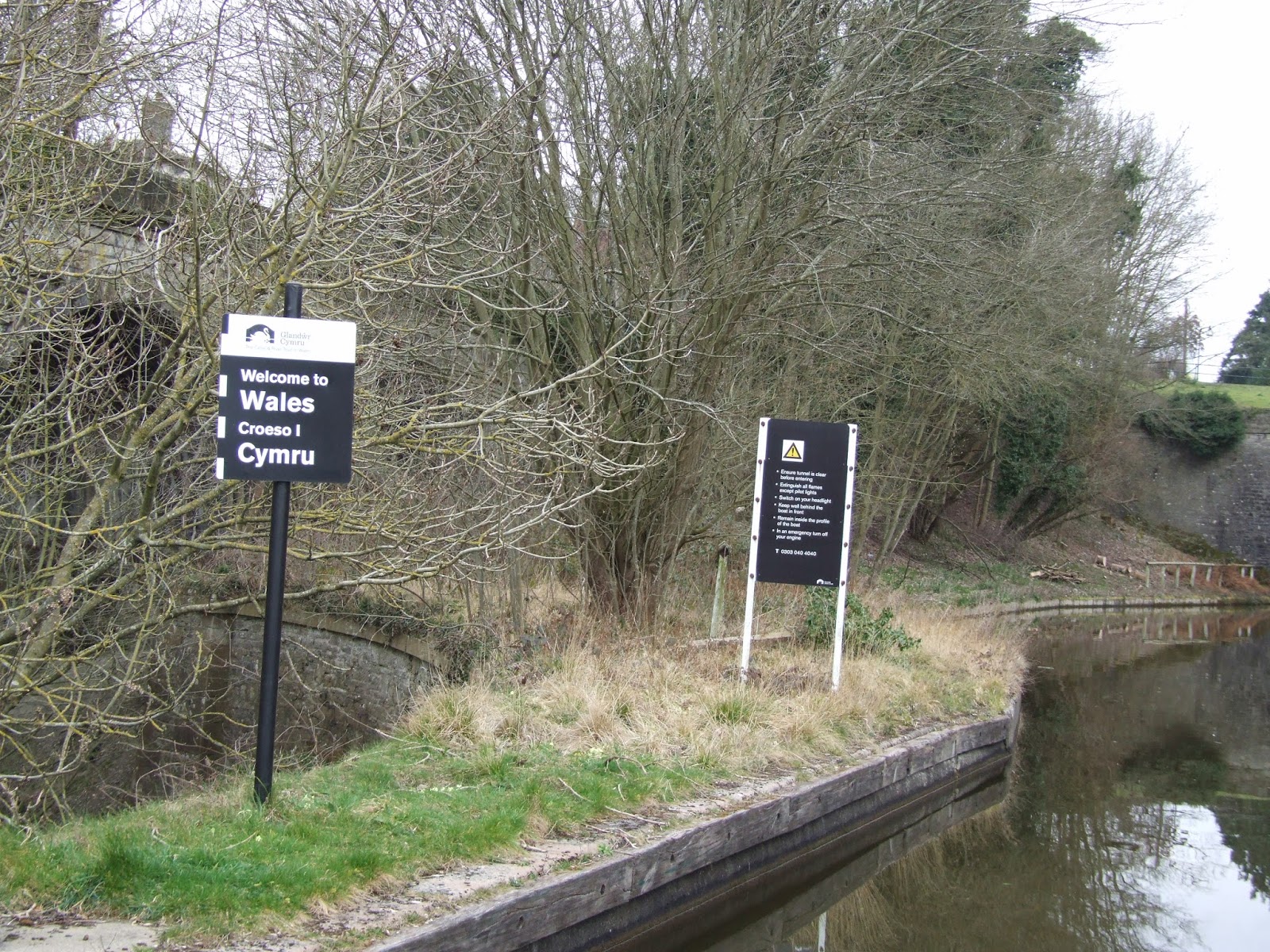
Here’s an interesting thing. On one side of the aqueduct there is a sign, Welcome to Wales. Walking over the bridge there is another sign, Welcome to England. So who own's the aqueduct?
Welcome to Wales
Welcome to England

Imagine, now, that your parents are Scottish. A couple with a love for canal boats. Suppose they were on a canal tour of the Marches at the time you were born, on the boat, just as they were crossing the Chirk Aqueduct.

What are you? Welsh, English, Scottish? Do you get to choose? You might choose Scottish and grab a free university education. You might, instead, value Welsh citizenship and hold out for a few more years to claim your pensioner's bus pass that can you can use in Wales and England. Or then again, you might choose to be English, so that… let me think about this for a moment. Yes, I know, you can wear that single star on your England football shirt that says how you won the World Cup Forty-seven years ago.


Sunday, 13 March 2016

New Caravan Season. Top 5 Tips

This has nothing to do with the post, I just like the picture
 of this lovely spot we found by a steam in Hay-on-Wye.
 Two days after I took the photo, though, the water level had
 reached the top of the bank, there were whole trees heading
 down stream, and we were prepped for the fasted  pack
 since records began.

I can see from the daffodils and the crocuses that Spring is with us once more, and soon it will be time to set out on our first caravan outing of the 2016 season. It's an exciting time of year, and I've been looking through old photographs, like this, getting in the mood.


I thought it might be useful to compile a top ten list of things for all you eager caravanners to peruse before we all hit the road.


I could only think of six items, though. 


No doubt I'll remember the other four items once we get pitched on site. Here's the list:
  1. Get the caravan serviced. Done. We take our ‘van to Derby for her service. It’s eighty miles each way but hey, you get a run out, and it feels almost like a holiday except you get to come home and sleep in your own bed at night. Except this year we slept in a cold and dreary budget hotel bed, having put the wrong date for a scifi thing I was doing, in my diary. It’s a long, unhappy and complex story, one for another day, perhaps. Anyway, we’ve been properly servicing our ‘van since we upgraded three or four years ago , and the process is still a bit of a novelty. The old approach used to be: set out into the wilderness. Pitch. See what breaks. As methods go, it worked. Most stuff broke. Things you absolutely need to be working in spring (which is really winter but with photos of daffodils on the calendar) would always break first, like the electrics, the heater, the water heater, the cooker… Spring is a really good time to find all the water leaks too. In our older vans, leaks didn’t mean cold spots that show up on a damp meter, leaks meant waking up in the morning with rain slapping you in the face. Yeah, so now we get the ‘van serviced.
  2. Check the items you took out of the van last year, and put them back. Yeah, a good tip. We once arrived without the bedding. Try spending the night under your coats and jumpers and the old smelly rug from the boot of the car. That will cure you of any laissez-faire attitude to check lists, I promise.
  3. Gas! This is an old favourite. You run out of gas towards the end of the season and you say, yeah, we’ll get some after the winter. It's a choice: End your autumn break with a meal in the pub, or shell out twenty quid, instead, for gas that you're not going to use for another four months. A meal wins every time. Or does it? Can you remember how good it tasted, four months ago, when right now it's gone midnight, and you’re outside with your head in the bottle locker, and you’re in your jammies, your head-torch strapped to your forehead, and there’s frost glistening on the outside of the ‘van. You swap the bottle over and you shout ‘okay! Try that,’ and you know what answer you’re going to get because that spare gas bottle felt awfully light when you moved it.
  4. Food. If you’re like us your caravan doubles as your winter larder. You’re out of pasta? No worries, there’s some in the ‘van. Need some cereal? A tin of peaches? Bin bags? People who aren't caravaners just don’t have this resource. They have to get in the car and drive to the supermarket. And so should you, my friend, because that first caravan outing can turn into a hungry affair.
  5. It makes sense to keep the wellies in the shed over winter. You’ll be using them in the garden. But it would have been good if you’d put them back in the ‘van afterwards, because your white trainers or your carpet slippers just don’t hack it when you have to walk across a meadow that is so slick with mud the Aquaroll you’re towing doesn’t even get enough traction to turn, it just… drags. You find your way back to the tap a few hours later by following the mud slide. 
  6. At home it can be useful to have some spare towels in the winter. Sometimes it’s hard keeping on top of the laundry, what with so many bad drying days (so my wife tells me). We caravaners are lucky to have a store of dry towels at the end of the garden. Not so lucky when we forget to replace them, and our daily trip to the shower block during the spring try-out becomes ever-more miserable, because your only towel has become nothing more than a wet rag that you use to rub the water around on your body. The walk back to the van in the sub-zero easterly can be quite bracing when you’re wearing your dry cloths on top of wet skin.
So there you have my top six. I hope you find this useful. If stumble upon the other four, please let me know.
Here’s to the new season.

Happy Caravanning folks!       


Sunday, 7 February 2016

1982: The Year the Car Caught Fire

 I was so proud of this car. My 1970 Ford Escort cost me £150 and we had her for years. She started out blue, gradually turned red, then ended her days as a smart Buckingham Green. I hunted through the photo shoebox for these pictures of her, because this afternoon I passed by Low Hill, in Liverpool, and a memory came back to me of the fateful day in 1982 that she caught fire.

1982 was the year of the Falklands War, the raising of the Mary Rose from the Solent, and the launch of Channel Four, when we all gathered round the TV to watch Richard Whitely and Carol Vorderman present Countdown, and to be amazed at now having four TV channels to watch. But for me, 1982 stands out as the year the car caught fire.

My alarm didn’t ring. I’d missed my train. I lived in Wallasey in those days, and I worked at the bus depot near Penny Lane, the same Penny Lane as in the Beatles’ song. (In fact I used to be a regular at Tony Slavin’s barber shop, the one that features in the song. He certainly knows my head, but as far as I’m aware he doesn’t have a photo of it.)

Anyway, I got up late and decided I’d have to go to work in the car. Rail and bus travel were free on my staff pass, so the cost of tolls for the Mersey Tunnel, and petrol at a scandalous 37pence per litre, was most upsetting.

I got through the tunnel without mishap (now shuddering to think what would have happened had my later mishap occurred in the tunnel) and straight up to the top of Low Hill. I stopped at the traffic lights outside the Coach and Horses, an iconic white pub, right on the junction. The first thing I noticed was the smell. Kind like a chemical works going up. I thought, hmm, something’s burning nicely round here. Then I noticed how the paint on the car bonnet had started to bubble. Then came the smoke. The engine was on fire. I jumped out of the car. What do you do when your car engine catches fire? Open the bonnet, I thought, because I don’t want the fire to damage the paintwork any more than it already has.


Now, I need to explain something. When you buy a car for £150 you can’t expect all the gadgets to work properly. This car had her share of small faults and idiosyncrasies (for example the wheels weren’t all the same size and the brakes sometimes caused the direction indicators to come on) and one of those small faults was that the cable for the bonnet catch had long ago snapped, so access to the engine bay was via a special, long, Phillips screwdriver that I kept in the boot. There was also a technique for getting in the boot, so there I was, blocking up one of Liverpool’s busier junctions in the thick of the rush hour, with smoke coming out of the bonnet, lying in the road trying to open the boot.
I attracted an audience.
I popped the boot, grabbed my special screwdriver, ran to the front of my car and dropped to my knees so I could poke through the special hole in the grill with my special screwdriver. I had become pretty slick at doing this, but billowing smoke and fire added to the pressure, and it took a while. At last though, a satisfying pop and the bonnet sprung open. Then there’s a catch that you had to find without burning your fingers. I used the screwdriver again and swung open the bonnet. Flames and black acrid smoke billowed out. I rocked back on my heels. It didn’t look as though much of the paintwork could be saved. I had nothing to use on the fire, but I could see what had happened. The plastic air filter box (that had no bolts, lost long ago) had fallen onto the exhaust manifold, and it was this that was burning. If I could just get it out of the engine bay… Think!

There was on old rug in the boot. I kept it there to lie on when I was crawling under the car on wet days. It had seen good service and was covered in oil, and I thought I could use it to smother the flames. Back round to the boot, grab the rug, round to the engine again; I threw the rug over the flames and success, the fire was gone. A cheer from the audience, still gathering outside the Coach and Horses.

But then the rug burst into flames. Gasps from the crowd. In hindsight an oil-soaked rug is not the best flame retardant item in your apprentice fire-fighter’s tool kit. Now the flames were properly taking hold. All seemed lost until the driver of the bus that was stuck in the queue of traffic behind me, pushed past.
“Mind out, mate!”
He had the fire extinguisher from the bus. Woosh! The show was over. He and some of the audience helped me push the car onto the cobbles in front of the pub, and rush hour got under way once more.

“I guess you want me to tow her straight to a scrapyard?” This was the RAC man. (or AA, can’t remember which one I was using that year. I switched between them often so that I wouldn’t become too infamous and get myself blacklisted.)
  
“Scrapyard?” My voice came out as a squeak. “No. A garage, please. She’ll fix up fine.”
The RAC (or AA) man raised an eyebrow, then gave an incredulous shrug. “A garage it is then.”

I didn’t like his attitude, but then I got my own back. He attached a towrope, pulled forward, giving a little tug, and I responded by sliding down the rain-slicked cobbled slope straight into the back of his van. My foot had been hard on the brake but she just slid, wheels locked, as though on ice.

Mr RAC/AA got out, looked at the back of his van. No damage (my car never damaged anything, it just tended to crumble upon impact, leaving little piles of rust).
“Try using your brakes,” he said. I thought that was unfair.


I was right and he was wrong, though. The garage fitted a second-hand wiring loom for just twenty quid. I took the car home the next day and painted over the bare patches with red oxide primer. The photos were taken a few weeks after the fire. If you look closely above where the rear bumper should be, you’ll see where I painted ‘Red Oxide Owner’s Club’ as an attempt at humour. She stayed like that for several months until Sarah got me to paint over it in green.


You can read about the adventure of how she became a green car in Travelling in a Box. And also about the incident that finally ended her years of faithful service, once and for all.

Saturday, 30 January 2016

When Procrastination Fails

There is green stuff all over the caravan and she needs a clean before we take her for a service. It's the first rain-free Saturday since November so out of bed and straight into wellies and we're off. First, though is to remove one or two overhanging branches, because it's probably the dripping sap that's causing the verdant fecundity on the roof.  One or two branches! It started out that way. One branch, then two, then another, and then another... The plan called for half an hour of gentle pruning then an hour to wash the 'van then a relaxing afternoon's walk in the country.
But after a solid four hours of serious lumberjacking our plan was derailed. Sarah asked the obvious question, "What are we going to do with all the wood?" I had that worked out in advance. "The wheely bin's empty," I said. But unless the wheely bin had Tardis ambitions, I could see a flaw in the plan: we had more lumber than the Forestry Commission. "It will look better after a sandwich and  a cuppa'," I said.
It didn't.
We started to load it into the car ready for a trip to the tip. The council tip is my least favourite of weekend destinations for far too many reasons that I want to go into here. The forty-five minute queue is only one of them. We had no choice, though. We queued, we tipped, we went home for more. We returned and queued and tipped, and repeated, again and again, and each time my patience frayed a little more. My car is not yet a year old, and now looks like the inside of a timber mill, with sap on everything, despite the tarp I'd put down. Sap's like that - it finds the only bit you haven't covered then it oozes. Our tree has these purple floret thingys on all the branches, and when you touch them they disintegrate into a million tiny puff-balls and attach to the carpet, and no amount of hoovering will shift the buggers.
Three o'clock, though, and all finished. Except there's still a caravan to wash. By now, you have to understand, I have no grip left in my fingers and my legs are barely keeping me upright. But there is snow forecast by six, and tomorrow it will rain until June, so the caravan has to be washed or she'll be turning up for her service covered in green pasture. So as the light fades and the puddles begin to freeze I realise that I have to do this thing.
Do not be fooled by the blue sky. That is a late January blue sky. It signifies weather cold enough to chill your fingers off and freeze your feet to the inside of your wellies so that what you have on the end of your legs are these homogenous rubbery icy lumps. Then throw in the sopping wet jeans and you will appreciate that I'm feeling fairly sorry for myself. Sarah's not so happy, either, because she's down at ground level washing the walls and getting all the surplus ice water that's cascading down off the roof from my hose. My job's the hardest, though; the roof. You could graze cattle up there in all the green. Roofs are especially bad. I really hate cleaning them, at the best of times, because you can't reach anything. My brush-on-a-pole is great, but you can't apply any pressure, especially in the middle, and what I need more than a brush, today, is a Flymo.
But we worked on, and the caravan began to shine. It didn't take us an hour, it took us three. The light was all but gone by the time we finished, as had the feeling in our hands and our feet.
The job is done, though. She's booked in for a service in a couple of weeks and then we're ready for a new season. I want to start now. I'm building a list in my head of all the places I want to go. 2016, bring it on!

Afterword: Sarah took me for a meal in the pub as a reward for all our work. We even allowed ourselves a pudding, because according to my Fitbit we've each burned about 3000 calories, so what's a mere Chocolate Indulgence Sunday going to do? It was hard lifting the spoon though. Tomorrow we will ache. Tomorrow we will be the living dead. I know it. I've been there before.


Thursday, 3 September 2015

King of the Mountains

From Penrith there is an ‘A’ road that connects the Lake District with the North East. The A686 twists and turns and loops up to Hartside Top, a dizzy 1,915 feet then descends to the town of Alston. Next week it will be the scene of fierce cycling activity as the Tour of Britain passes through. There is much local anticipation, with flags and yellow-painted cycles decorating the route. It is not a good place to take a caravan!
I’ve told myself this before: Plan your route. In advance. Do not rely on satnav to do this for you. And I did. Honest. I had the whole thing figured out, but then I became seduced by the dulcet tones of the girl in the box. She seemed to have a better idea than me, with a plan that shaved off a whole six minutes from the five-and-a-half hour journey to Northumberland.
As if towing over Hartside Top isn’t bad enough on a quiet day, the upcoming Tour of Britain had brought out cyclists in their hundreds, keen to try it for themselves. So now there were dozens of pelotons to overtake along the way. Passing bikes is hard in a caravan. You have to make plenty of allowance for getting clear without swiping any of them into a ditch. On a twisty gradient, and with 50 mph lycra bullets coming at you the other way, downhill, it is the stuff of nightmares. People watched our progress, pointing and gasping in wonder. Who is that nutter, dragging a caravan up here? What is he trying to prove? The back of my neck still glows from the embarrassment.

The tale ends well, though. We didn’t kill any cyclists. We didn’t plunge down any ravines on the descent. We reached Beadnell Bay, in Northumberland, without incident, where we stayed for a few days with the CCC’s Motor Caravan Section at their Temporary Holiday site.

I adore Northumberland. It is a beautiful part of the country. The untamed coast alternates between long, golden sandy beaches and rocky coves, all interspersed with castles straight out of fantasy fiction. We last stayed here seven or eight years ago and we vowed to return, and not just for the fish and chips, although fish and chips was high on our to-do list.
On our first full day we walked and paddled along the beach, then over the headland into Seahouses, where the best fish and chips in the world are served. They do say one should eat local, so we did. Twice.


Now, a bit of advertising (sorry), or at least some sharing of good news. I’m chuffed to see that Travelling in a Box has been picking up some four and five star reviews of late, on both Amazon and Goodreads. Woohoo! Available on Kindle and in paperback.